
Monday, December 31, 2012
Paul Zahl: Grace = The Change Agent of Life
"Grace is one-way love. Take an inventory of yourself. Watch other people about whose happiness you care. You will see it over and over: one-way love lifts up. One-way love cures. One-way love transforms. It is the change agent of life."

Wednesday, December 26, 2012
I Like Adoption
If you haven't had an opportunity to watch this video yet, you should check it out. It is a powerful picture of the gospel.
Tuesday, December 25, 2012
Tim Keller: Christmas Is the End of Thinking You Are Better Than Someone Else

Christmas is the end of thinking you are better than someone else, because Christmas is telling you that you could never get to heaven on your own. God had to come to you. It is telling you that people who are saved are not those who have arisen through their own ability to be what God wants them to be. Salvation comes to those who are willing to admit how weak they are." [via]
Adapted from “Mary,” sermon by Tim Keller, Redeemer Presbyterian Church, New York, December 23, 2001.
Monday, December 24, 2012
Written Beneath A Crucifix
Powerful words penned by Les Miserables' Victor Hugo after the death of his daughter in 1847:
"You who weep, come to this God, for he weeps.
You who suffer, come to him, for he cures.
You who tremble, come to him, for he smiles.
You who pass, come to him, for he remains."
[via]
"You who weep, come to this God, for he weeps.
You who suffer, come to him, for he cures.
You who tremble, come to him, for he smiles.
You who pass, come to him, for he remains."
[via]
Monday, December 17, 2012
Sunday, December 16, 2012
We Were Made For So Much More
“You live in a deranged age, more deranged than usual, because in spite of great scientific and technological advances, man has not the faintest idea of who he is or what he is doing." - Walker Percy
Friday, December 14, 2012
The Essence of Christianity
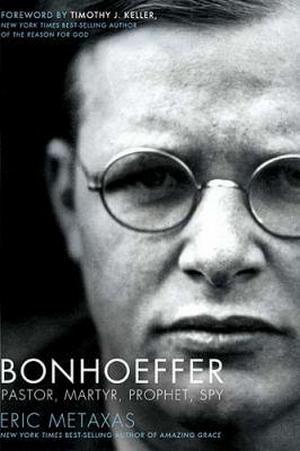
Last night I was reading Eric Metaxas' celebrated biography on Dietrich Bonhoeffer and I came across this summation of Bonhoeffer's theology in the words of Metaxas. I thought it was great:
"The essence of Christianity is
not about religion at all, but about the person of Christ... Religion was a dead, man-made thing,
and at the heart of Christianity was something else entirely—God himself.
[Bonhoeffer] aggressively attacked the idea
of “religion” and moral performance as the very enemies of Christianity and of
Christ because they present the false idea that somehow we can reach God
through our moral efforts.This led to hubris and spiritual
pride, the sworn enemies of Christianity. “Thus,” he said, “the Christian
message is basically amoral and irreligious, paradoxical as that may sound.”"
Thursday, December 13, 2012
Wednesday, December 12, 2012
We Were Made For So Much More

"A man who has no assured and ever present belief in the
existence of a personal God or of future existence with retribution and reward,
can have for his rule of life, as far as I can see, only to follow those
impulses and instincts which are the strongest or which seem to him the best
ones." - Charles Darwin
I agree with you Charles.
I agree with you Charles.
Tuesday, December 11, 2012
No Ifs, Ands, or Buts: The Message of Grace
This is a helpful reminder from Brennan Manning:
"My message, unchanged for more than fifty years, is this: God loves you unconditionally, as you are and not as you should be, because nobody is as they should be. It is the message of grace… A grace that pays the eager beaver who works all day long the same wages as the grinning drunk who shows up at ten till five… A grace that hikes up the robe and runs breakneck toward the prodigal reeking of sin and wraps him up and decides to throw a party no ifs, ands, or buts… This grace is indiscriminate compassion. It works without asking anything of us… Grace is sufficient even though we huff and puff with all our might to try to find something or someone it cannot cover. Grace is enough… Jesus is enough." [via]
"My message, unchanged for more than fifty years, is this: God loves you unconditionally, as you are and not as you should be, because nobody is as they should be. It is the message of grace… A grace that pays the eager beaver who works all day long the same wages as the grinning drunk who shows up at ten till five… A grace that hikes up the robe and runs breakneck toward the prodigal reeking of sin and wraps him up and decides to throw a party no ifs, ands, or buts… This grace is indiscriminate compassion. It works without asking anything of us… Grace is sufficient even though we huff and puff with all our might to try to find something or someone it cannot cover. Grace is enough… Jesus is enough." [via]
Friday, December 7, 2012
Gerhard Forde: Christian Progress
"Am I making progress? If I am really honest, it seems to
me that the question is odd, even a little ridiculous. As I get older and death
draws nearer, I don’t seem to be getting better. I get a little more impatient,
a little more anxious about having perhaps missed what this life has to offer,
a little slower, harder to move, a little more sedentary and set in my ways.
Am
I making progress? Well, maybe it seems as though I sin less, but that may only
be because I’m getting tired! It’s just too hard to keep indulging the lusts of
youth.
Is that sanctification? I wouldn’t think so! One should not, I expect,
mistake encroaching senility for sanctification! But can it be, perhaps, that
it is precisely the unconditional gift of grace that helps me to see and admit
all that? I hope so. The grace of God should lead us to see the truth about
ourselves, and to gain a certain lucidity, a certain humor, a certain
down-to-earthness." [via]
Thursday, December 6, 2012
Michael Horton: The Only Reason I Can Sleep Well At Night
“My conscience does not render a positive verdict in God’s courtroom when I look inside myself. The only reason I can sleep well at night is that even though my heart is filled with corruption and even though I am not doing my best to please him, I have in heaven at the Father’s right hand the beloved Son, who has not only done his best for himself but has fulfilled all righteousness for me in my place."
From Christless Christianity via OFI
From Christless Christianity via OFI
Tuesday, December 4, 2012
Charles Spurgeon: Without the Cross...
"Without the cross there would have been a wound for which there was no ointment, a pain for which there was no balm." [source]
Monday, December 3, 2012
Erwin Lutzer: He Bore the Sting For Us
"Jesus went through darkness that we might have light. He was cursed that we might be blessed. He was condemned that we might be able to say, "Therefore there is now no condemnation for those who are in Christ Jesus." He suffered hell for us that we can enjoy heaven with Him...
Sin, like a loathsome serpent, clung to Him, but He bore the sting for us. We can hide behind the wall of His grace and know that we are safe from wrath."
Sin, like a loathsome serpent, clung to Him, but He bore the sting for us. We can hide behind the wall of His grace and know that we are safe from wrath."
Sunday, December 2, 2012
A Hole In Our Holiness?

This review is an incredible look at the human condition (even post-regeneration) and it is rubbing a lot of Christians the wrong way. Personally, I agree with the theology behind what Mark is saying.
Mark is gracious in his critique of the book, and refreshingly honest about his own struggles.
If you have the time, stop by CT and read the review in its entirety. For everyone else, here are some highlights:
"What I've discovered is this: The older I've grown, the more I realize how layered and subtle is my sin; the more spiritually mature I am, the more I realize, along with Jeremiah, how desperately wicked my heart is. In that sense, as I run the last laps of life, I'm much less impressed with my outward progress, and more aware than ever of my sin, and more and more in a constant state of repentance. Others compliment me on my "progress"—I no longer have a temper, I'm more considerate of my wife, more compassionate toward others, and so on and so forth. But they cannot see my heart, and if they did, they'd run in fear, repelled by the cauldron evil that remains. Perhaps I've simply failed in the pursuit of holiness. Or maybe the pursuit of holiness is not so much a striving to adopt a life of habitual virtue but learning how to live a life of constant repentance.
[DeYoung] says that those who pursue a righteous life are “susceptible to judgmentalism and arrogance.” What I think he fails to see is that those who pursue holiness with the passion that he pleads for are more than “susceptible” to these temptations; they will inevitably become self-righteous. This is my personal testimony and the witness of history. DeYoung points us to the Puritans as examples of holiness. But there is a reason that the Puritans have a reputation for priggishness and self-righteousness. Having been a student of the Puritans myself, I know their movement started out with the best of motives—to live godly lives in a sinful world. But their passion for holiness led inevitably to self-righteousness. Their historical reputation is due in part to secular bias, but it is also due to historical facts.
…while I applaud the reminder that we are called to be holy, and while I recognize that there is some deliberate effort involved, I believe that a conscious and purposeful pursuit of holiness is about the worst way to go about it. I cannot think of a person I know or a historical figure who has aspired to holiness without suffering from spiritual pride. This has certainly been the case in my own spiritual journey. The times I have deliberately tried to become godly are when I have become most like the devil—irritable, judgmental, arrogant, and prideful to start with. The paradox is when I stop trying to be holy, and simply repent as the sinner I am, I become more patient, kind, and loving."
Right on Mark!
Right on Mark!
Saturday, December 1, 2012
Ray Ortlund: How to Read the Bible
"There are two ways to read the Bible. We can read it as law or as promise.
If we read the Bible as law, we will find on every page what God is telling us we should do. Even the promises will be conditioned by law. But if we read the Bible as promise, we will find on every page what God is telling us he will do. Even the law will be conditioned by promise.
In Galatians 3 Paul explains which hermeneutic is the correct one. “This is what I mean: the law, which came 430 years afterward, does not annul a covenant previously ratified by God, so as to make the promise void. For if the inheritance comes by the law, it no longer comes by promise; but God gave it to Abraham by a promise” (Galatians 3:17-18).
So, if we want to know whether we should read the Bible through the lens of law or grace, demand or provision, threat or promise — if we want to know how to read the Bible in an apostolic rather than a rabbinic way — we can follow the plot-line of the Bible itself and see which comes first. And in fact, promise comes first, in God’s word to Abram in Genesis 12. Then the law is “added” — significant word, in Galatians 3:19 — the law is added as a sidebar later, in Exodus 20. The hermeneutical category “promise” establishes the larger, wraparound framework for everything else added in along the way.
The deepest message of the Bible is the promises of God to undeserving law-breakers through his grace in Christ. This is not an arbitrary overlay forced onto the biblical text. The Bible presents itself to us this way. The laws and commands and examples and warnings are all there, fulfilled in Christ and revered by us. But they do not provide the hermeneutic with which we make sense of the whole. We can and should understand them as qualified by God’s gracious promise, for all who will bank their hopes on him." [source]
Friday, November 30, 2012
3 Sermon Recommendations
There have been three messages lately that have really stuck with me, and I thought I would share them with you. If you are looking for Christ-centered, grace-filled preaching, here you go:
First, Tullian Tchividjian preached a message last week entitled God Comes Down Part 1. It is fantastic! Definitely check that one out. You will be blessed by it. I was able to listen to it again this morning and it was even better the second time.
Dr. Warren Gage, of Knox Theological Seminary, preached what I would describe as a theological masterpiece. If you want to hear a man preach Christ with both knowledge and zeal - give this a listen.
Lastly, Timothy Keller's message entitled Justified by Faith could be a case study in how to preach the gospel to an audience ranging from the pious to the skeptic. It's a gem that speaks to the very heart of mankind and provides the only possible solution to our ills - Jesus.

First, Tullian Tchividjian preached a message last week entitled God Comes Down Part 1. It is fantastic! Definitely check that one out. You will be blessed by it. I was able to listen to it again this morning and it was even better the second time.
Dr. Warren Gage, of Knox Theological Seminary, preached what I would describe as a theological masterpiece. If you want to hear a man preach Christ with both knowledge and zeal - give this a listen.
Lastly, Timothy Keller's message entitled Justified by Faith could be a case study in how to preach the gospel to an audience ranging from the pious to the skeptic. It's a gem that speaks to the very heart of mankind and provides the only possible solution to our ills - Jesus.

Wednesday, November 28, 2012
CJ Mahaney: Singing the Gospel To Yourself
If you watch this video, you are in for an 8.5 minute gospel feast. This is the good stuff. Why churches and minsters would talk about anything else perplexes me.
[via]
[via]
Tuesday, November 27, 2012
Becoming Increasingly More Aware of My Need of Christ

"If you understood just how desperate you were, just how broken you were, you would be unapologetic in your clinging to God's grace."
I think the speaker is right. I so often fail to understand my own desperate need of Christ on a daily basis. Pride and self-sufficiency are always right outside my door waiting to overtake me. May God help me realize, once again, my need of His grace and my utter dependence on Him.
Monday, November 26, 2012
William Romaine: Pardoned
“It is true, I have sin in me, but it is pardoned. God has forgiven me all trespasses. I stand before him in my surety, who undertook for me, and I am perfect in him. The Father chose me in his Son: he looks upon the face of his Beloved, and sees me in him. In him he is well pleased, so he is with me. As he loves him, so he loves me. This is the glorious privilege which by faith I now enjoy.
I deny sight and sense, and I stick to the word of God. I adhere strictly to its testimony concerning me, believing myself to be dead indeed unto sin in Christ, and in him absolutely freed from guilt and condemnation. The Father is at peace with me, and he loves me in his Son, and with the same love with which he loves him—his Father and my Father." [via]
Saturday, November 24, 2012
The Truth Hidden In Plain Sight
"For the scientist who has lived by his faith in the power of reason, the story ends like a bad dream. He has scaled the mountains of ignorance, he is about to conquer the highest peak; as he pulls himself over the final rock, he is greeted by a band of theologians who have been sitting there for centuries." - Robert Jastrow (astronomer) [source]
Tuesday, November 20, 2012
John Newton: Boasting is Excluded for Christians
This is theological gold:
“They [true Christians] love much, because much has been forgiven them. They dare not, they will not ascribe anything to themselves—but are glad to acknowledge, that they must have perished (if possible) a thousand times over, if Jesus had not been their Savior, their shepherd, and their shield. When they were wandering—he brought them back; when fallen—he raised them; when wounded—he healed them; when fainting—he revived them. By him, out of weakness—they have been made strong: he has taught their hands to war, and covered their heads in the day of battle.
“They [true Christians] love much, because much has been forgiven them. They dare not, they will not ascribe anything to themselves—but are glad to acknowledge, that they must have perished (if possible) a thousand times over, if Jesus had not been their Savior, their shepherd, and their shield. When they were wandering—he brought them back; when fallen—he raised them; when wounded—he healed them; when fainting—he revived them. By him, out of weakness—they have been made strong: he has taught their hands to war, and covered their heads in the day of battle.
In a word, some of the clearest proofs they have had of his excellence, have been occasioned by the humiliating proofs they have had of their own vileness. They would not have known so much of him—if they had not known so much of themselves.” [via]
Newton's words bring to mind this story from Luke's Gospel.
Newton's words bring to mind this story from Luke's Gospel.
Monday, November 19, 2012
Jacob Goff: Permission to Sin?

I instinctively bristle at writing like this, but perhaps this is exactly the kind of thing I need to hear on a daily basis. This is the writing of someone who has experienced God's scandalous grace. Enjoy:
“Should we sin all the more that grace may abound?” This is the question Paul anticipates his hearers to ask after he explains how deep grace goes. I had never anticipated this question - despite spending tons of time in church growing up. Why not? Because most preachers are afraid to preach like Paul.
Today, we think anticipating this question is necessarily sinful. You heathens - we think - of course all you care about is how much you can get away with. And we suppress our own impulse to ponder this question. But what if this question is an indication - the indication - that we are beginning to wrap our minds around the gospel?
If you leave a pastor’s sermon and this question is rolling around in your head, “Does this mean I can do whatever I want?” then your probably beginning to understand.
Like many things in this mad world, asking the right questions is a harder task than having the right answer. But Paul’s answer is important: Should we sin all the more that grace may abound? By no means. Or, colloquially, Hell no! But then, he goes right back to talking about grace. Paul doesn’t say, Of course you idiots are obsessed with what you can get away with – you need to be more spiritual like me! He knows talking that way will only encourage pharisaism, and he also knows that this is the point that will help us see God’s love for us in Jesus at its starkest and most offensive level. The truth is, God just keeps on forgiving.
So, if our impulse is to sin after hearing about grace, what is the cure? More meditating on the gospel. More grace. (Read Romans 6 for yourself, Paul seems obsessed with Christ’s work on our behalf. The climax grows and grows, Romans 8 – there is therefore now no condemnation for those in Jesus Christ. And if you think Paul is, like many pastors, going to point you to your strength and determination to make your life right with God, take a gander at the chapter sandwiched between these two, Romans 7, “I do the things I don’t want to do, who is going to deliver me from this body of death?” Thanks be to God, indeed. We need Jesus more than we imagined!)
So, does God’s forgiveness mean we have permission to sin? Can we just keep on sinning?
Robert Farrar Capon writes:
God, in the act of creating you, gave you permission to do any damned fool thing you could mangage to bring off. Forgiveness neither increases nor decreases God permissiveness; instead, it just fishes us out of the otherwise inescapable quicksand we so stupidly got ourselves into and says, ‘There! Isn’t that better?’
To repeat the central point of this post, and perhaps the bible, God just keeps on forgiving you. Should we keep on sinning? No! But don’t expect God to suddenly stop forgiving you. Christ blood covers your rebellion – all of it." [via]
Saturday, November 17, 2012
Subscribe to:
Posts (Atom)